Evaluating Autumn Story: A Practical Guide to Building Custom Fall Scenes with Modular Clipart
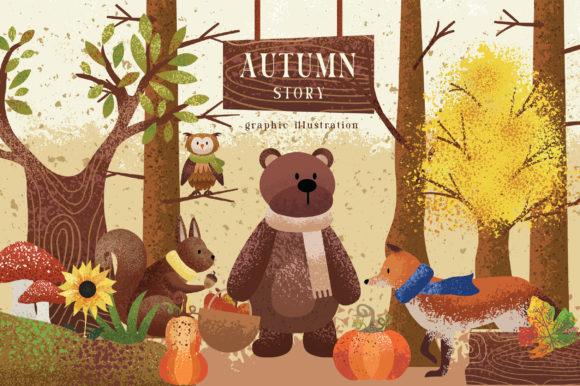
For designers, educators, and content creators working on seasonal projects, the challenge often lies not in finding assets, but in finding assets that offer flexibility. Generic stock photography can feel stiff, while rigid vector packs often lack the warmth required for autumn-themed storytelling. This is where Autumn Story enters the conversation as a distinct resource. Rather than providing a single static image, this collection functions as a modular toolkit designed for scene construction. It offers a curated set of graphic illustrations featuring animals, flora, and landscape elements that allow users to compose their own unique fall environments.
When evaluating digital resources for commercial or personal projects, it is essential to look beyond the surface aesthetics and consider the technical specifications and compositional freedom they provide. Autumn Story distinguishes itself by focusing on "scene building" rather than just "image downloading." With over 100 individual elements ranging from wildlife to terrain features, it caters to those who need to tailor a visual narrative to specific spatial requirements.
The Core Composition: Animals and Character Elements
The heart of any seasonal illustration often lies in its characters. In the context of Autumn Story, the animal selection is strategically divided to maximize versatility. The pack includes 14 distinct animals, a number that provides variety without overwhelming the user with redundant options. What makes this specific selection notable for comparison purposes is the inclusion of variation within the species. Seven of these animals are depicted wearing scarves, while the other seven are shown without.
This dichotomy is a significant practical advantage. In many standard clipart collections, an animal is presented in a single state. If a designer needs a fox for a warm, cozy indoor scene, a scarf might be appropriate. However, if that same fox needs to be placed in an active, running pose outdoors, a scarf might clutter the silhouette or imply a different weather condition than intended. By providing both versions, Autumn Story removes the need for users to digitally edit the asset to remove clothing, preserving the integrity of the original 300 DPI resolution. This level of forethought in the asset creation process saves time during the design phase and allows for more nuanced storytelling.
Constructing the Environment: Flora, Terrain, and Props
A compelling autumn scene requires more than just characters; it needs a stage. The environmental assets in this collection are broken down into granular components, allowing for a "layered" approach to design. The botanical elements include 12 flowers, 15 leaves, and 9 stems. Separating leaves and stems from whole plants is a critical feature for users who wish to create custom arrangements, such as falling foliage effects or specific floral borders that do not exist in pre-made packs.
The collection also addresses the ground plane and structural elements necessary for depth. Users gain access to 6 rivers, 6 land masses, 7 bushes, 5 rocks, and 4 trees. When comparing this to all-in-one background images, the value proposition shifts toward control. A pre-rendered background locks the perspective and lighting. In contrast, having separate river and land elements allows a creator to adjust the horizon line, create winding paths, or place a specific tree exactly where the composition rules (such as the rule of thirds) demand it.
Furthermore, the inclusion of harvest-specific props like 6 pumpkins, 2 apples, and 3 mushrooms adds thematic weight. These items serve as focal points or foreground details that guide the viewer's eye. For example, placing mushrooms near the base of a tree or scattering apples along a path can create a sense of scale and interaction between the environment and the animal characters.
Technical Specifications and Format Considerations
In the realm of digital design, the utility of an asset is heavily dependent on its file format and resolution. Autumn Story delivers its content in PNG format at 300 DPI. This specification is vital for professionals evaluating print versus digital use cases.
- 300 DPI Resolution: This is the industry standard for high-quality printing. Whether the end product is a greeting card, a classroom poster, or a printed storybook, this resolution ensures that edges remain crisp and colors do not pixelate when scaled. Many free online resources only offer 72 DPI, which is sufficient for screens but disastrous for print.
- PNG Transparency: The Portable Network Graphics format supports alpha channels, meaning every element comes with a transparent background. This eliminates the need for manual background removal, a task that can be tedious and often results in jagged edges if done poorly. This feature makes the assets "drop-in" ready for software like Adobe Photoshop, Illustrator, Canva, or Procreate.
Additionally, the pack includes structural aids such as 4 borders and 6 frames. These are particularly useful for users creating invitations, certificates, or page layouts where the content needs to be contained within a defined aesthetic boundary. The presence of these framing elements suggests the creator considered the final application of the art, not just the art itself.
Pre-made Scenes vs. Custom Construction
A common question when purchasing asset packs is whether the time investment required to build a scene from scratch is worth it. Autumn Story addresses this balance by including 3 pre-made scenes in JPG format alongside the individual PNG elements. This hybrid approach offers the best of both worlds.
For users facing tight deadlines or those who lack confidence in their compositional skills, the pre-made JPGs provide an immediate solution. They serve as finished products that can be used instantly for social media posts, quick handouts, or inspiration boards. However, the true power of the package lies in the ability to deconstruct these ideas and rebuild them. A user might take the composition of a pre-made scene but swap the animal character or change the type of foliage to better match a specific brand palette or narrative requirement.
When comparing this to services that offer only custom illustration commissions, the tradeoff is clear. Commissioning an artist provides total uniqueness but comes with high costs and long turnaround times. Using a generic stock photo is fast but offers zero customization. Autumn Story sits in the middle: it requires some assembly time but offers a high degree of uniqueness at a fraction of the cost of custom work.
Ideal Use Cases and Limitations
Understanding where Autumn Story fits best helps in making an informed purchasing decision. This resource is ideally suited for:
- Educational Materials: Teachers creating worksheets, bulletin boards, or story sequencing cards will find the separate elements invaluable for explaining concepts like habitats or life cycles.
- Small Business Branding: Boutique owners, cafe managers, or event planners looking to create cohesive autumn marketing materials without hiring a graphic designer.
- Scrapbooking and Paper Crafts: The high-resolution PNGs are perfect for digital scrapbooking or printing out for physical collage work.
- Web and App Design: Developers needing lightweight, scalable assets for seasonal website updates or game backgrounds.
However, there are limitations to consider. Because the style is illustrative and cohesive, it may not blend seamlessly with photorealistic assets or vastly different art styles (e.g., pixel art or minimalist line drawings). Users looking for a highly specific, non-standard artistic direction might find the unified style of the pack restrictive. Additionally, while 14 animals provide good variety, a project requiring a vast zoo of diverse species might need to supplement this pack with additional resources.
Making the Decision
Ultimately, choosing Autumn Story depends on the priority of flexibility versus immediacy. If the goal is to have a single, unchangeable image, a standard stock photo site might suffice. But if the objective is to craft a specific mood, tell a tailored story, or produce multiple variations of a design theme, the modular nature of this collection offers superior value. The combination of high-resolution technical specs, thoughtful character variations (scarf vs. no scarf), and comprehensive environmental layers makes it a robust tool for anyone looking to bring a personalized touch to their autumn projects.